Arithmetic Progressions — Notes
📑 Chapter Navigator
01
5.1 What is an AP?
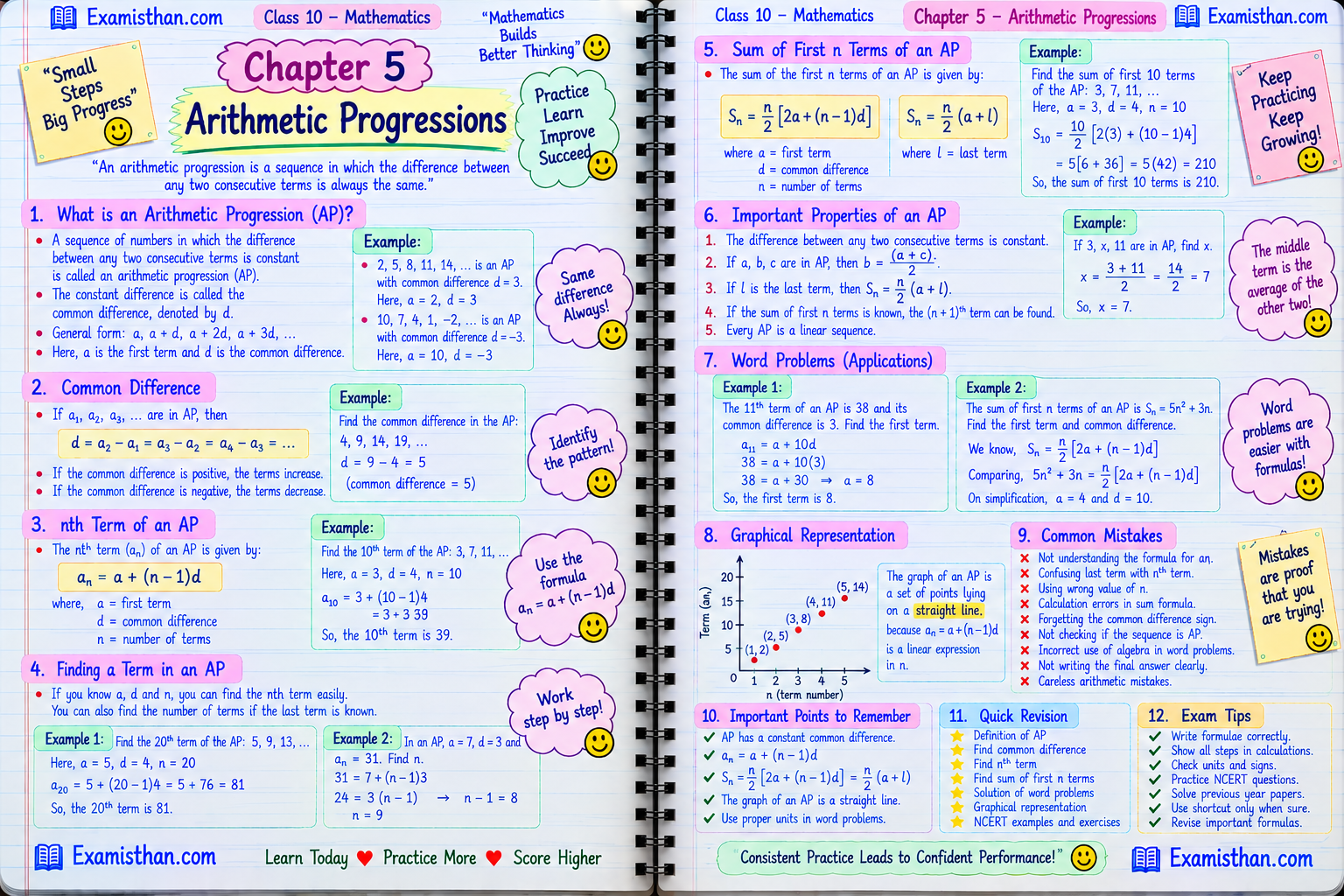
An arithmetic progression is a sequence in which the difference between consecutive terms is constant. This constant is the common difference d.
Notation
If the first term is a, the AP is a, a+d, a+2d, ....
02
5.2 nth Term
The nth term of an AP is an = a + (n−1)d. This formula is used when a particular term number is required.
03
5.3 Sum of First n Terms
The sum of the first n terms is Sn = n/2 [2a+(n−1)d].
Alternative form
If the last term is l, then Sn = n/2(a+l).
04
5.4 Finding Unknown Terms
Use the common-difference condition and the nth-term formula to form equations. In many problems, terms are expressed in terms of a and d before solving.
05
5.5 Applications
APs model equally increasing or decreasing quantities, such as seating arrangements, savings patterns, and regular numerical sequences.
⚡ Quick Revision
- AP: consecutive difference is constant.
- aₙ=a+(n−1)d.
- Sₙ=n/2[2a+(n−1)d].
- Sₙ=n/2(a+l).
🎯 Board Exam Focus
- Identify a and d before substituting.
- Use n−1, not n, in the nth-term formula.
- For decreasing APs, d is negative.
🚀 Last-Minute Revision
✔ Read every formula with its conditions and symbols.
✔ Write given data first and keep units consistent.
✔ For proofs, state the theorem and show logical steps.
✔ Check signs, substitutions and final units.
❤️ Examisthan.com • Class 10 CBSE Mathematics • Chapter 5: Arithmetic Progressions