Probability — Notes
📑 Chapter Navigator
01
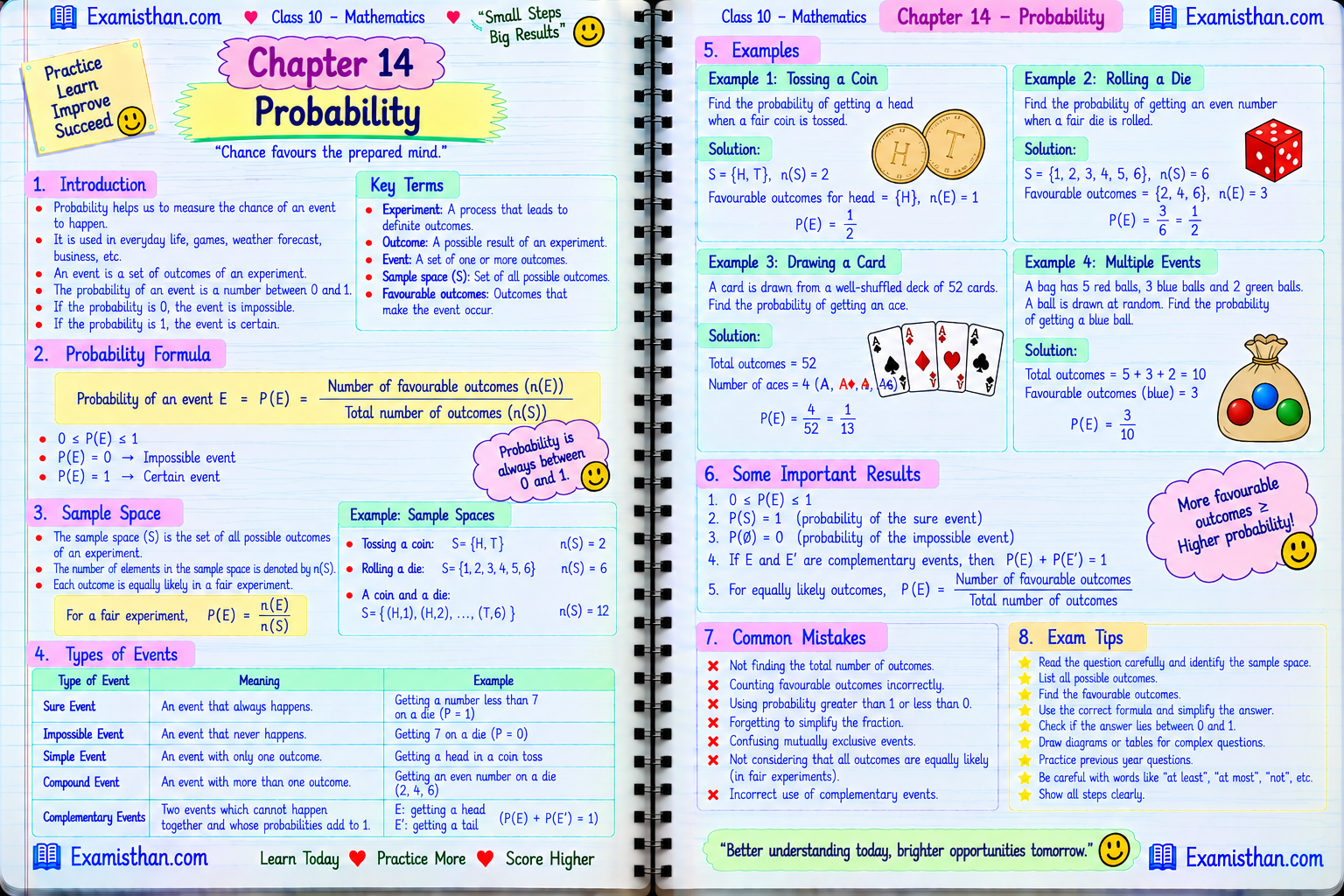
14.1 Random Experiment
An experiment with a clearly defined set of possible outcomes, where the exact outcome cannot be predicted with certainty in advance, is a random experiment.
02
14.2 Sample Space and Event
The sample space is the set of all possible outcomes. An event is a collection of one or more outcomes from the sample space.
03
14.3 Classical Probability
When outcomes are equally likely, the probability of event E is:
P(E)=Number of favourable outcomes / Total number of outcomes.
P(E)=Number of favourable outcomes / Total number of outcomes.
04
14.4 Range and Complement
For every event E:
0 ≤ P(E) ≤ 1
and P(not E)=1−P(E).
0 ≤ P(E) ≤ 1
and P(not E)=1−P(E).
05
14.5 Common Problems
Typical Class 10 problems use coins, dice, cards and simple selection situations. First write the sample space or count total equally likely outcomes, then count favourable outcomes.
⚡ Quick Revision
- Probability lies between 0 and 1.
- P(E)=favourable outcomes/total equally likely outcomes.
- P(not E)=1−P(E).
- Certain event has probability 1; impossible event has probability 0.
🎯 Board Exam Focus
- Check that outcomes are equally likely before using the classical formula.
- Do not count an outcome twice.
- Use the complement when it is easier to count the opposite event.
🚀 Last-Minute Revision
✔ Read every formula with its conditions and symbols.
✔ Write given data first and keep units consistent.
✔ For proofs, state the theorem and show logical steps.
✔ Check signs, substitutions and final units.
❤️ Examisthan.com • Class 10 CBSE Mathematics • Chapter 14: Probability