Quadratic Equations — Notes
📑 Chapter Navigator
01
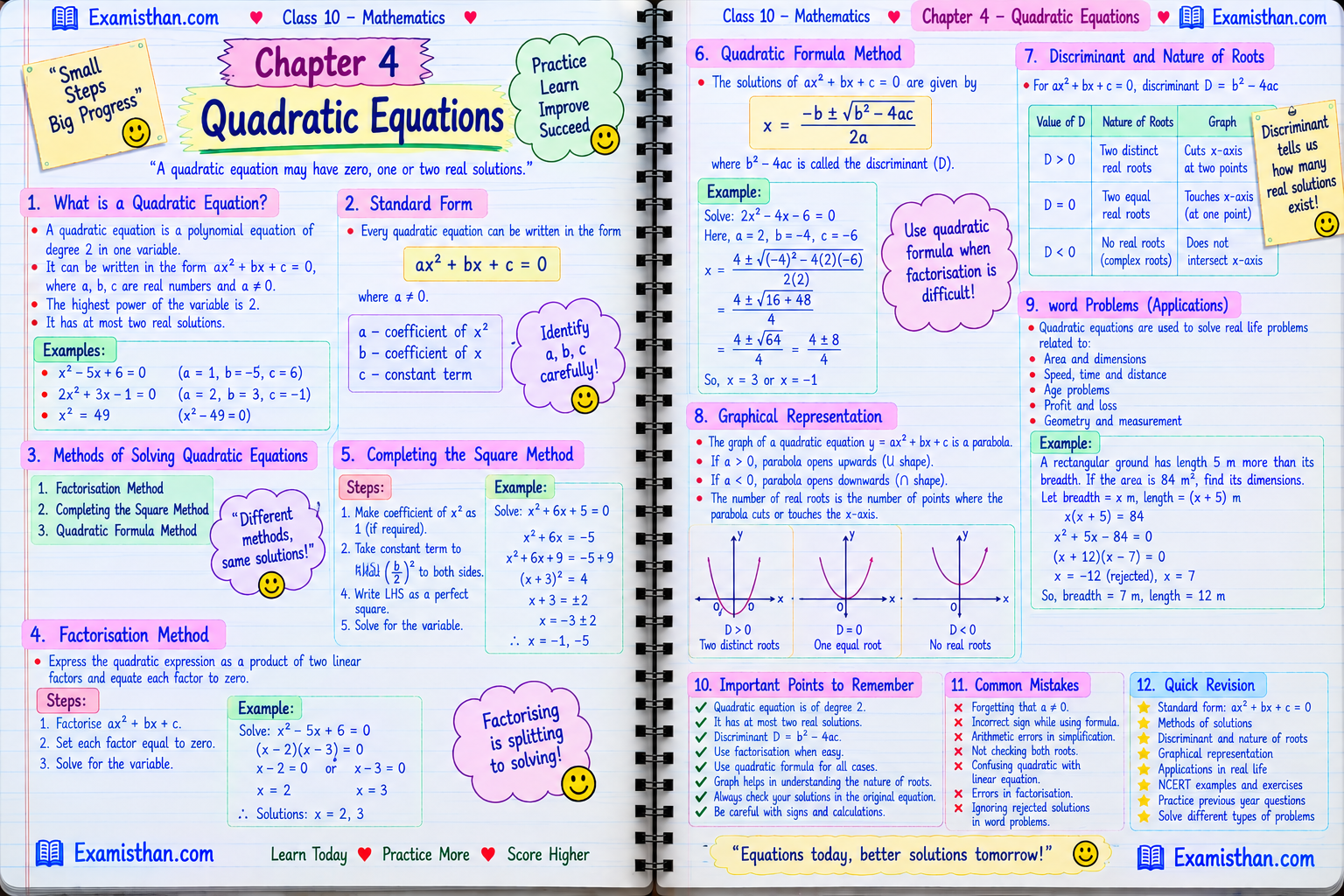
4.1 Standard Form
A quadratic equation is ax2+bx+c=0, where a ≠ 0. The highest power of the variable is 2.
02
4.2 Factorisation
Rewrite the quadratic as a product of two linear factors and use the zero-product property. If (x−p)(x−q)=0, then x=p or x=q.
03
4.3 Completing the Square
Transform ax2+bx+c=0 into a square expression. This method is useful for deriving the quadratic formula and for equations that do not factor easily.
04
4.4 Quadratic Formula
For ax2+bx+c=0:
x = (−b ± √(b2−4ac))/(2a).
x = (−b ± √(b2−4ac))/(2a).
Discriminant
The quantity D=b2−4ac determines the nature of roots.
05
4.5 Nature of Roots
D > 0: two distinct real roots.
D = 0: two equal real roots.
D < 0: no real roots.
D = 0: two equal real roots.
D < 0: no real roots.
Useful relations
If roots are α and β, then α+β=−b/a and αβ=c/a.
⚡ Quick Revision
- Standard form: ax²+bx+c=0, a≠0.
- D=b²−4ac.
- D>0 distinct real; D=0 equal real; D<0 no real roots.
- Quadratic formula works for every quadratic equation.
🎯 Board Exam Focus
- Write a, b and c explicitly before using the formula.
- Do not forget the ± sign.
- Simplify √D only after calculating D.
🚀 Last-Minute Revision
✔ Read every formula with its conditions and symbols.
✔ Write given data first and keep units consistent.
✔ For proofs, state the theorem and show logical steps.
✔ Check signs, substitutions and final units.
❤️ Examisthan.com • Class 10 CBSE Mathematics • Chapter 4: Quadratic Equations