Real Numbers — Notes
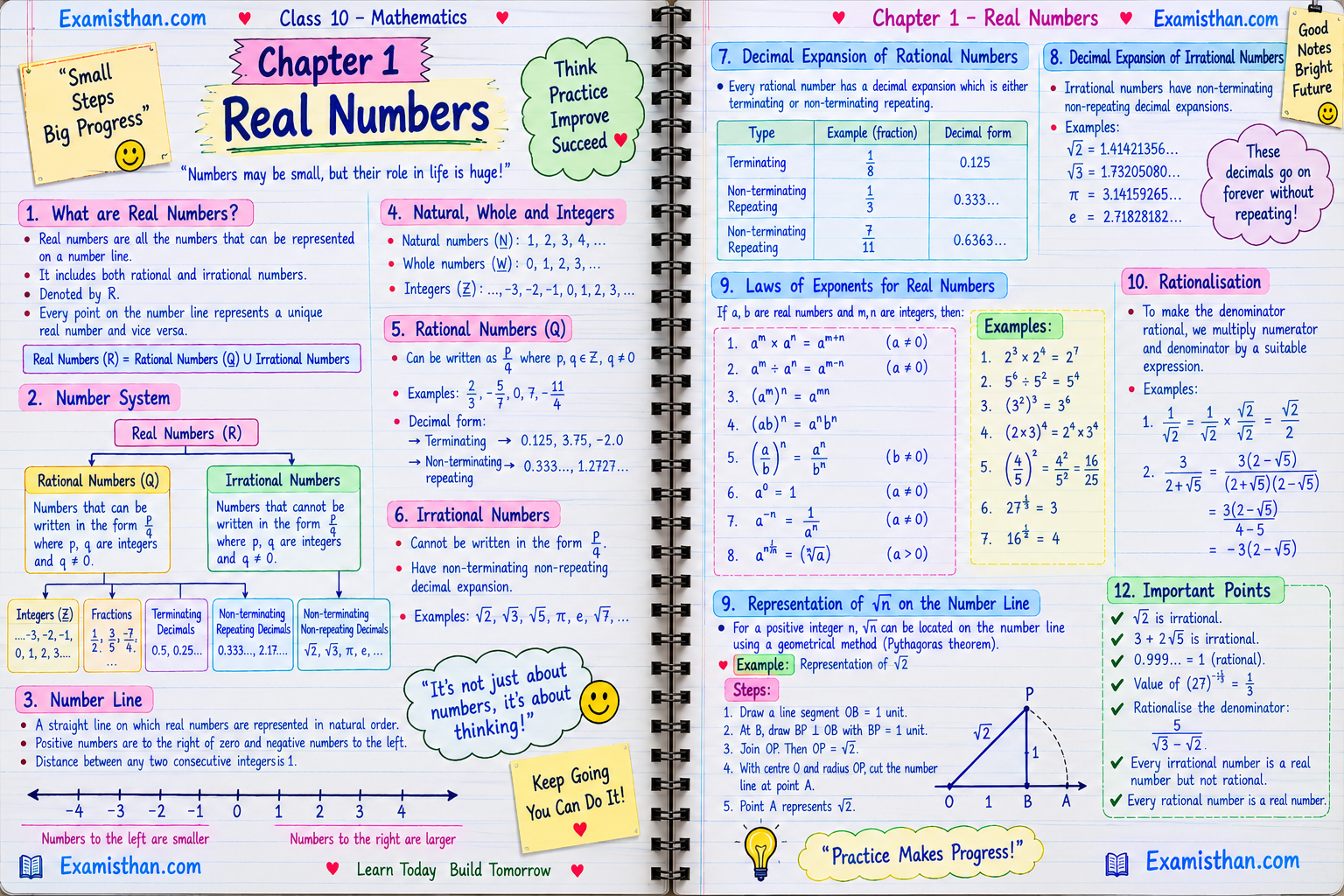
📑 Chapter Navigator
01
1.1 Euclid’s Division Lemma
For positive integers a and b, there exist unique integers q and r such that
a = bq + r, where 0 ≤ r < b. Here q is the quotient and r is the remainder.
Repeated application of this result gives Euclid’s division algorithm, which is a systematic method for finding the HCF of two positive integers.
HCF by Euclid’s Algorithm
To find HCF(867, 255):
867 = 255 × 3 + 102
255 = 102 × 2 + 51
102 = 51 × 2 + 0
Therefore HCF = 51.
867 = 255 × 3 + 102
255 = 102 × 2 + 51
102 = 51 × 2 + 0
Therefore HCF = 51.
02
1.2 Fundamental Theorem of Arithmetic
Every composite number can be expressed as a product of primes, and this prime factorisation is unique apart from the order of the factors.
For example, 360 = 23 × 32 × 5.
HCF and LCM from prime factors
For HCF, take the smallest powers of common prime factors. For LCM, take the greatest powers of all prime factors involved.
Important identity
For two positive integers a and b:
HCF(a,b) × LCM(a,b) = a × b.
HCF(a,b) × LCM(a,b) = a × b.
03
1.3 Irrational Numbers
A real number is irrational if it cannot be written in the form p/q, where p and q are integers and q ≠ 0.
NCERT uses proof by contradiction to establish results such as √2, √3 and √5 are irrational.
Proof pattern
Assume the number is rational in lowest terms. Derive that numerator and denominator must share a prime factor, contradicting the assumption that the fraction is in lowest terms.
04
1.4 Decimal Expansion of Rational Numbers
For a rational number p/q in lowest form, the decimal expansion terminates exactly when the prime factorisation of q contains no primes other than 2 and 5.
If q has any other prime factor, the decimal expansion is non-terminating recurring.
Examples
7/40 terminates because 40 = 23 × 5.
13/24 is non-terminating recurring because 24 = 23 × 3 contains 3.
13/24 is non-terminating recurring because 24 = 23 × 3 contains 3.
⚡ Quick Revision
- Euclid: a = bq + r, 0 ≤ r < b.
- Prime factorisation is unique apart from order.
- HCF uses minimum powers; LCM uses maximum powers.
- √p is irrational for prime p.
- A reduced p/q terminates iff q = 2m5n.
🎯 Board Exam Focus
- Practice Euclid algorithm carefully and stop when remainder becomes 0.
- Always reduce p/q to lowest form before testing its decimal expansion.
- For irrationality proofs, explicitly state the contradiction.
- Use HCF × LCM = product only for two positive integers.
🚀 Last-Minute Revision
✔ Read every formula with its conditions and symbols.
✔ Write given data first and keep units consistent.
✔ For proofs, state the theorem and show logical steps.
✔ Check signs, substitutions and final units.
❤️ Examisthan.com • Class 10 CBSE Mathematics • Chapter 1: Real Numbers