Statistics — Notes
📑 Chapter Navigator
01
13.1 Grouped Data
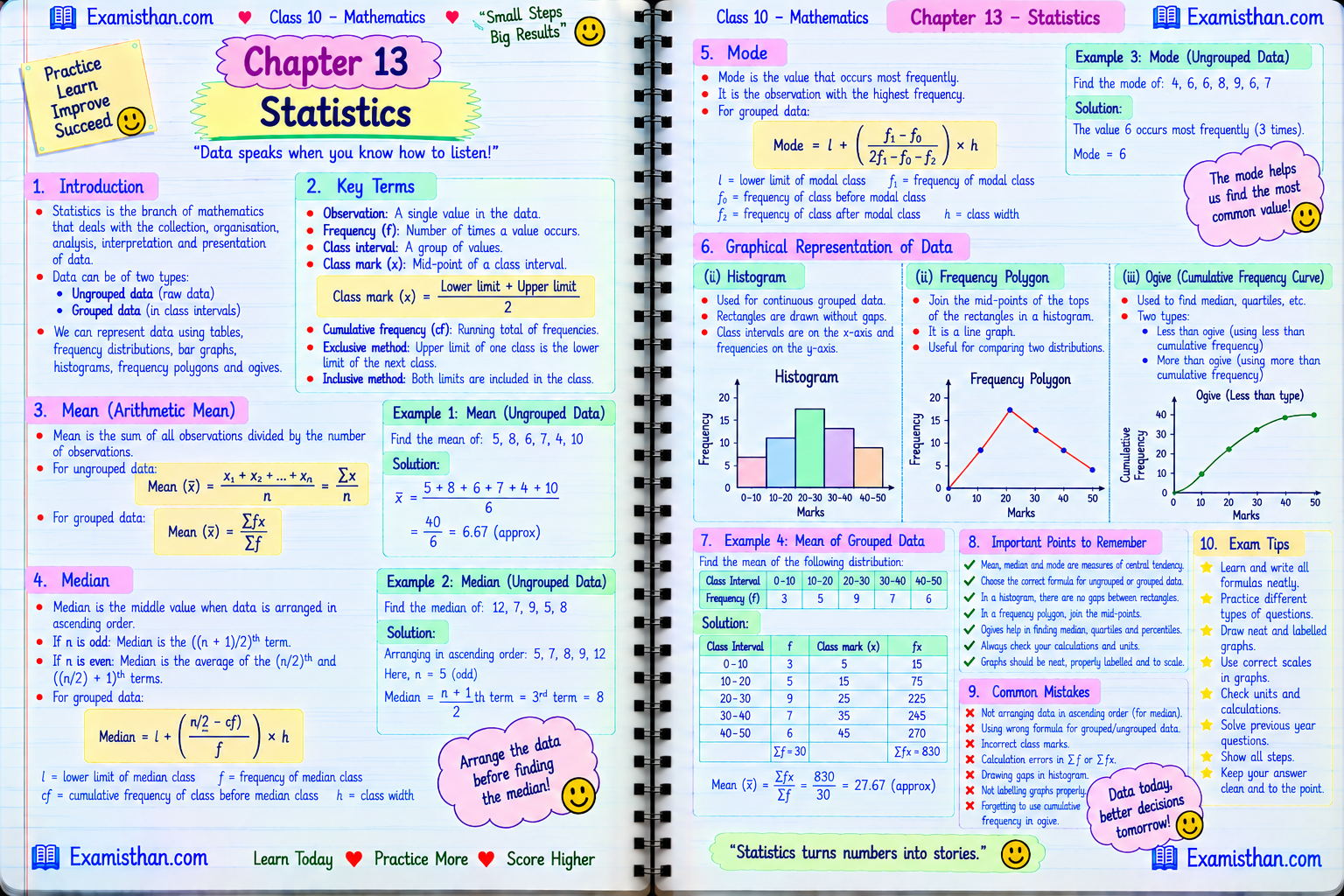
For grouped observations, class intervals are accompanied by frequencies. The class mark is the midpoint of a class interval: xi=(upper limit+lower limit)/2.
02
13.2 Mean by Direct Method
For grouped data, Mean = Σfixi / Σfi.
03
13.3 Assumed Mean Method
Choose an assumed mean A and let di=xi−A. Then:
Mean = A + Σfidi/Σfi.
Mean = A + Σfidi/Σfi.
04
13.4 Step-Deviation Method
When class marks have a common class width h, let ui=(xi−A)/h. Then:
Mean = A + h(Σfiui/Σfi).
Mean = A + h(Σfiui/Σfi).
05
13.5 Median of Grouped Data
For grouped data, identify the median class using N/2 in the cumulative-frequency column, then apply the grouped-data median formula:
Median = l + [(N/2 − cf)/f]h.
Median = l + [(N/2 − cf)/f]h.
06
13.6 Mode of Grouped Data
Identify the modal class with the highest frequency and use:
Mode = l + [(f1−f0)/(2f1−f0−f2)]h.
Mode = l + [(f1−f0)/(2f1−f0−f2)]h.
⚡ Quick Revision
- Class mark = midpoint.
- Mean = Σfx/Σf.
- Median uses N/2 and the median class.
- Mode uses the highest-frequency class.
🎯 Board Exam Focus
- Use continuous class boundaries when required.
- Build cumulative frequency carefully.
- Identify l, h, f, cf and N before substitution.
🚀 Last-Minute Revision
✔ Read every formula with its conditions and symbols.
✔ Write given data first and keep units consistent.
✔ For proofs, state the theorem and show logical steps.
✔ Check signs, substitutions and final units.
❤️ Examisthan.com • Class 10 CBSE Mathematics • Chapter 13: Statistics