Electricity — Notes
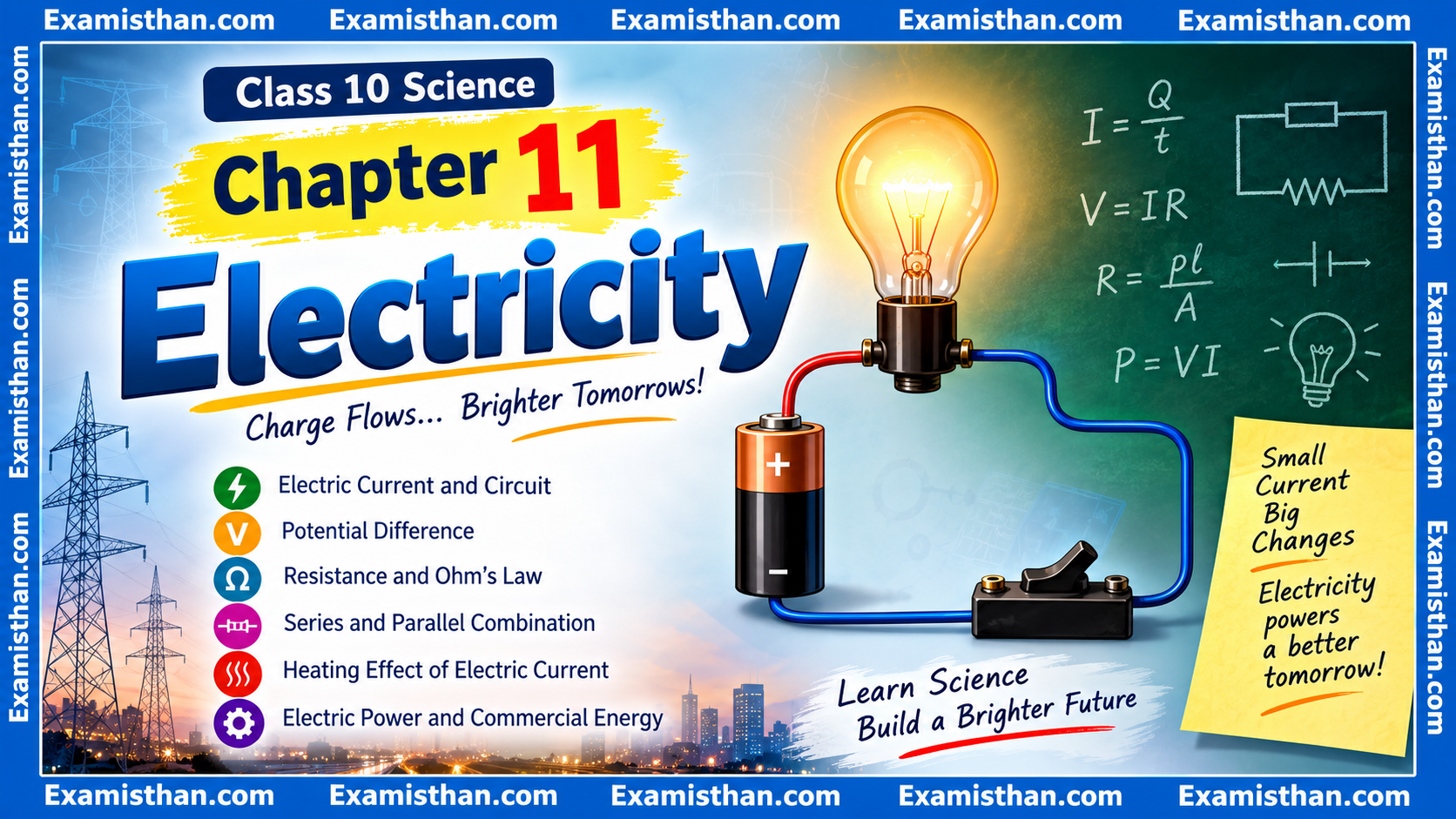
⚡ Chapter 11: Electricity
Electric Current • Potential Difference • Resistance • Ohm's Law • Heating Effect • Electric Power
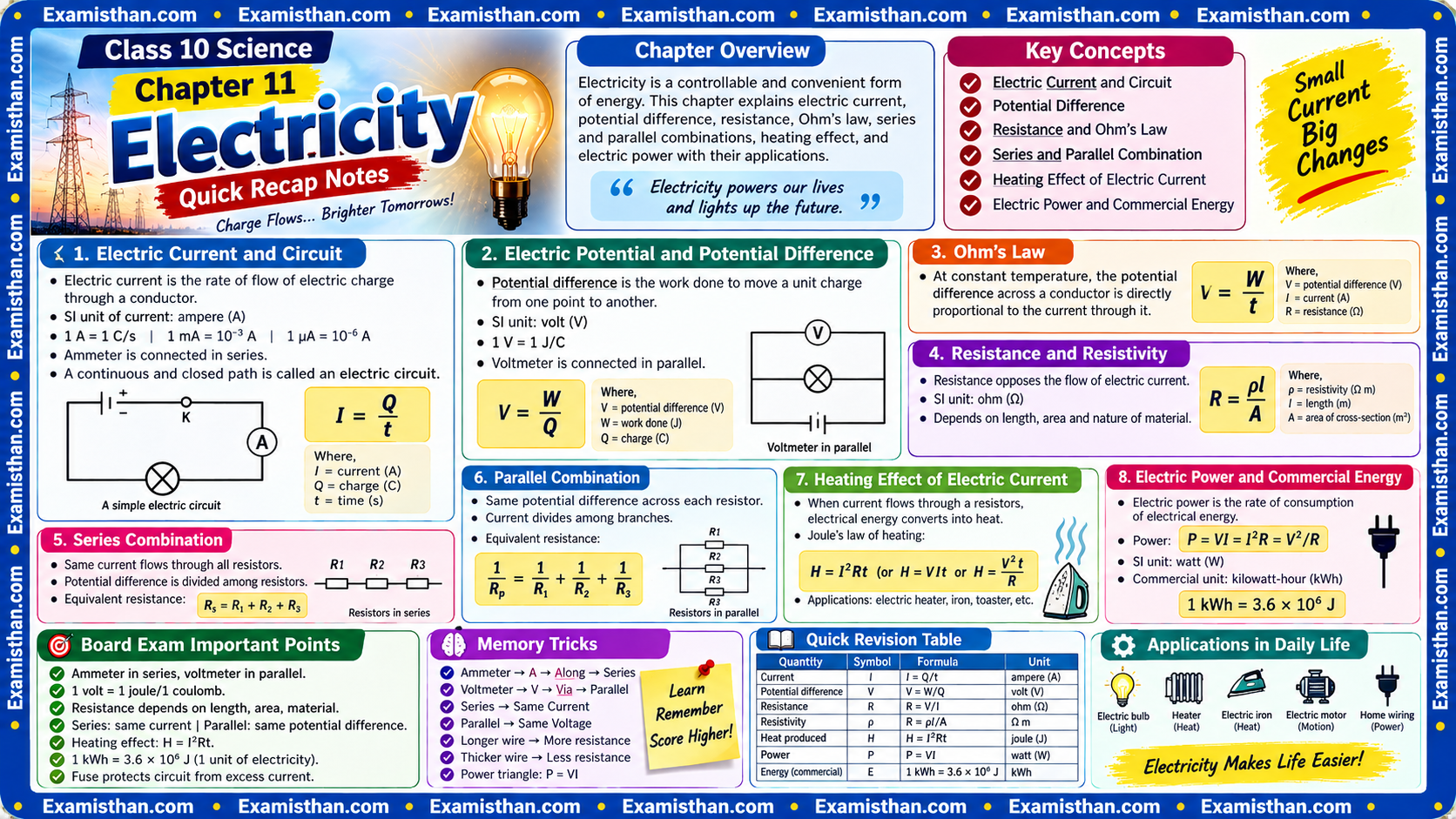
📘 Chapter Overview
Electricity is a form of energy associated with electric charges. In an electric circuit, charges flow through a conducting path when there is a potential difference across the conductor.
In this chapter, we study electric current, potential difference, resistance, Ohm's law, resistivity, combinations of resistors, heating effect of current, electric power and electrical energy. These concepts are important for both theory questions and numerical problems.
⚡ 1. Electric Current
Electric current is the rate of flow of electric charge through a conductor.
Where: I = electric current, Q = electric charge, t = time.
The SI unit of current is ampere (A). One ampere of current means that one coulomb of charge flows through a conductor in one second.
🔋 2. Potential Difference
The potential difference between two points is the work done to move a unit charge from one point to another.
Where: V = potential difference, W = work done, Q = charge.
The SI unit of potential difference is the volt (V).
🔌 3. Resistance
Resistance is the property of a conductor that opposes the flow of electric charge.
A conductor with high resistance allows less current to flow for a given potential difference, while a conductor with low resistance allows more current to flow.
The SI unit of resistance is the ohm (Ω).
📐 4. Ohm's Law
According to Ohm's Law, the potential difference across the ends of a metallic conductor is directly proportional to the current flowing through it, provided the temperature and other physical conditions remain constant.
Here R is the constant of proportionality and represents the resistance of the conductor.
🔍 5. Factors Affecting Resistance
📏 Length
Resistance increases when the length of the conductor increases.
⭕ Area of Cross-section
A thicker conductor has a larger cross-sectional area and generally offers less resistance.
🧪 Material
Resistance depends on the nature of the material. This property is represented by resistivity.
🧪 6. Resistivity
Resistivity is a characteristic property of the material of a conductor. It is represented by the symbol ρ (rho).
Therefore:
- Resistance increases with the length of the conductor.
- Resistance decreases when the cross-sectional area increases.
- Resistance also depends on the material through its resistivity.
The SI unit of resistivity is Ω m.
🔀 7. Combination of Resistors
| Feature | Series | Parallel |
|---|---|---|
| Current | Same current flows through every resistor. | Current divides among different branches. |
| Potential Difference | Potential difference is divided among resistors. | Same potential difference exists across each branch. |
| Equivalent Resistance | Rs = R1 + R2 + R3 | 1/Rp = 1/R1 + 1/R2 + 1/R3 |
| If one device fails | The circuit path is broken. | Other branches can continue to operate. |
| Domestic Wiring | Not suitable. | Suitable because appliances can operate independently. |
📏 Ammeter
An ammeter is used to measure electric current in a circuit.
🔋 Voltmeter
A voltmeter measures the potential difference between two points in a circuit.
🔥 9. Heating Effect of Electric Current
When electric current flows through a resistor, electrical energy is converted into heat energy. This is called the heating effect of electric current.
The heat produced depends on:
- Square of current: H ∝ I²
- Resistance: H ∝ R
- Time for which current flows: H ∝ t
Applications include electric heaters, irons, toasters, electric kettles and other heating appliances.
⚙️ 10. Electric Power
Electric power is the rate at which electrical energy is consumed or electrical work is done.
1 kWh = 3.6 × 10⁶ J
1 kWh is commonly called 1 unit of electrical energy.
🛡️ 11. Fuse – Safety Device
A fuse is a safety device used to protect electrical circuits and appliances from excessive current.
When an unduly high current flows through the fuse wire, the wire becomes hot and melts. This breaks the circuit and prevents further flow of current.
🧮 Important Formulas
✏️ Solved Numerical Example
A resistor of resistance 5 Ω is connected to a 10 V battery. Find the current flowing through the resistor.
Using Ohm's Law:
Therefore, I = V/R = 10/5 = 2 A
Answer: 2 A🎯 Board Exam Quick Points
🚀 Last-Minute Revision
Remember the concepts first and then apply the correct formula in numerical questions.