Our Environment — Notes
Our Environment
Chapter Overview
An environment contains living organisms and the physical surroundings with which they interact. This chapter explains how the components of an ecosystem depend on one another, how energy moves through food chains and food webs, how harmful chemicals can accumulate in organisms, and how human activities affect the environment.
Biotic and abiotic components interacting together.
Show feeding relationships and trophic levels.
Energy flows progressively through trophic levels and is lost at each step.
Human activities affect ozone and waste disposal.
1. Ecosystem — Components
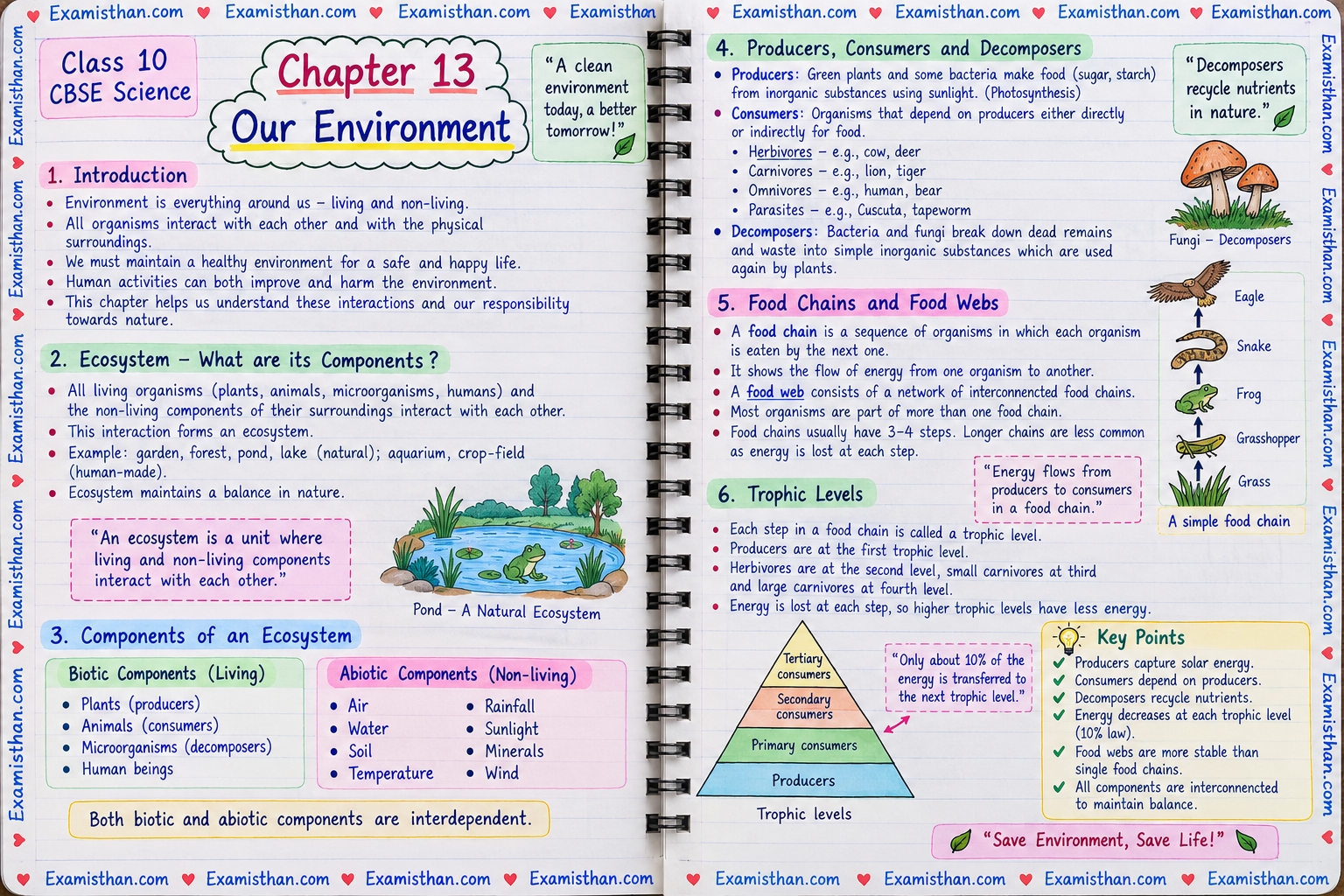
An ecosystem consists of all the interacting organisms in an area together with the non-living constituents of the environment. Organisms and their physical surroundings interact with each other and help maintain a balance in nature.
Biotic components
These are the living organisms of an ecosystem, such as plants, animals, microorganisms and human beings.
Abiotic components
These are the non-living physical factors such as temperature, rainfall, wind, soil and minerals.
2. Aquarium as a Human-Made Ecosystem
An aquarium can be designed as a small ecosystem. Fish need free space for swimming, water, oxygen and food. Oxygen can be provided using an oxygen pump or aerator, and fish food can be supplied separately.
3. Producers, Consumers and Decomposers
Producers
Green plants and certain bacteria that produce food by photosynthesis are called producers. They make organic compounds such as sugar and starch from inorganic substances using radiant energy from the Sun in the presence of chlorophyll.
Consumers
Consumers obtain food directly from producers or indirectly by feeding on other consumers. They include herbivores, carnivores, omnivores and parasites.
Decomposers
Microorganisms such as bacteria and fungi break down dead remains and waste products. They convert complex organic substances into simple inorganic substances that return to the soil and can be used by plants.
4. Food Chains and Trophic Levels
A food chain is a series of organisms feeding on one another. Each step or feeding position in a food chain is called a trophic level.
Producers / autotrophs
Herbivores / primary consumers
Small carnivores / secondary consumers
Larger carnivores / tertiary consumers
5. Food Web
A food chain is often not a simple straight sequence because one organism may be eaten by two or more kinds of organisms, which may themselves be eaten by several other organisms. Such interconnected feeding relationships are represented as a food web.
- A food chain shows a particular sequence of feeding relationships.
- A food web consists of many interconnected food chains.
- Food chains can vary greatly in length and complexity.
6. Flow of Energy in an Ecosystem
Autotrophs capture energy from sunlight and convert it into chemical energy. This energy supports the activities of the living world and moves from producers to consumers and decomposers.
Energy captured by autotrophs does not return to the solar input, and energy passed to herbivores does not return to autotrophs. Thus, energy flow is unidirectional.
Energy available at each trophic level progressively diminishes because energy is lost to the environment, including as heat.
- Green plants in a terrestrial ecosystem capture about 1% of the sunlight falling on their leaves and convert it into food energy.
- An average of about 10% of the food eaten is turned into the consumer's own body and made available to the next level.
- Because so little usable energy remains for higher levels, food chains generally contain only three or four steps.
7. Biological Magnification
Some pesticides and other harmful chemicals enter the soil or water. Plants can absorb these chemicals along with water and minerals, and aquatic plants can take them up from water bodies. These chemicals may then enter food chains.
8. How Do Our Activities Affect the Environment?
Human beings are an integral part of the environment. Environmental changes affect us, while our activities also change the environment. The chapter focuses on two environmental problems: depletion of the ozone layer and waste disposal.
Ozone at higher levels of the atmosphere shields Earth's surface from harmful ultraviolet radiation from the Sun.
Increasing quantities of waste, especially non-biodegradable waste, create serious environmental problems and require responsible management.
9. Ozone and Ozone Layer Depletion
Ozone (O3) is a molecule made of three oxygen atoms. Unlike molecular oxygen (O2), which is essential for aerobic life, ozone is a deadly poison at ground-level concentrations. However, at higher levels of the atmosphere it performs an essential protective function.
Formation of ozone
O + O2 → O3
High-energy UV radiation splits some molecular oxygen (O2) into free oxygen atoms. These oxygen atoms then combine with molecular oxygen to form ozone.
10. Biodegradable and Non-Biodegradable Waste
Enzymes are specific in their action, so a particular enzyme is needed to break down a particular substance. Many human-made materials, such as plastics, are not broken down by bacteria or other saprophytes under the ambient conditions found in the environment and therefore persist for a long time.
Biodegradable
Substances that can be broken down by biological processes are called biodegradable substances.
Non-biodegradable
Substances that are not broken down by biological processes are called non-biodegradable substances. They may persist for a long time or harm members of the ecosystem.
11. Managing the Garbage We Produce
Modern lifestyles have resulted in greater amounts of waste. Changes in packaging and the increasing use of disposable products have also increased the proportion of non-biodegradable waste.
- Spoilt food and vegetable peels
- Used tea leaves
- Milk packets and empty cartons
- Waste paper
- Medicine bottles, strips and bubble packs
- Old clothes and broken footwear
- How much waste is generated each day?
- How much of it is biodegradable?
- Are biodegradable and non-biodegradable wastes treated separately?
- How are sewage and industrial wastes treated?
- How can waste be reduced, reused or otherwise managed responsibly?
12. Disposable Cups — Environmental Impact
The chapter discusses the shift from reusable plastic glasses to disposable cups in trains. Plastic cups created disposal problems because millions could be discarded daily.
13. Sewage, Industrial Waste and E-Waste
The chapter asks students to investigate how sewage in their locality is treated and whether untreated sewage can pollute local water bodies.
Students are encouraged to find out how local industries treat their waste and how soil and water pollution can be prevented.
The chapter asks students to investigate hazardous materials associated with electronic items and their possible environmental effects.
14. Quick Revision Table
| Topic | Key point |
|---|---|
| Ecosystem | Biotic + abiotic components interacting in an area. |
| Biotic | Living organisms such as plants, animals and microorganisms. |
| Abiotic | Physical factors such as temperature, rainfall, wind, soil and minerals. |
| Producer | Makes food using radiant solar energy; forms the first trophic level. |
| Consumer | Obtains food directly or indirectly from producers. |
| Decomposer | Bacteria and fungi break down dead remains and wastes into simpler inorganic substances. |
| Trophic level | Each feeding step or level in a food chain. |
| Food web | A network of interconnected food chains. |
| Energy flow | Unidirectional; available energy diminishes at successive trophic levels. |
| 10% value | Average fraction of food eaten turned into the consumer's own body and available to the next level. |
| Biological magnification | Progressive accumulation of non-degradable harmful chemicals at successive trophic levels. |
| Ozone | O3; protects Earth's surface from UV radiation at higher atmospheric levels. |
| CFCs | Synthetic chemicals linked in the chapter to ozone depletion. |
| Biodegradable | Broken down by biological processes. |
| Non-biodegradable | Not broken down by biological processes and may persist for a long time. |
15. Board Exam Focus
- Biotic and abiotic components
- Producers, consumers and decomposers
- Trophic levels and food chains
- Food webs
- Unidirectional energy flow
- 10% transfer concept
- Biological magnification
- Ozone formation and protective role
- CFC-related ozone depletion
- Biodegradable vs non-biodegradable waste
- Waste disposal and environmental impact
- Sewage, industrial waste and e-waste
16. Important Activities to Revise
Design an aquarium and identify its requirements: space, water, oxygen and food.
Discuss dependence among producers, consumers and decomposers and form an aquatic food chain.
Think about pesticide sources in food and ways to reduce pesticide intake.
Investigate chemicals responsible for ozone depletion and regulations controlling their emissions.
Observe buried household waste over time and identify materials that change or remain unchanged.
Study local waste collection, sewage treatment, industrial waste and hazardous materials in electronic items.
Last-Minute Revision
Remember the central relationships: producers make energy from sunlight available to the ecosystem; energy decreases as it moves through trophic levels; harmful non-degradable chemicals can become concentrated at higher trophic levels; ozone protects against UV radiation; and waste may be biodegradable or non-biodegradable.